This season’s Christmas gift wrapping paper trends offer something for every style and occasion. Vintage-inspired prints, classic tartan plaids, and sustainable kraft paper provide timeless elegance. Metallic accents and minimalist monochrome wraps infuse presentations with modern sophistication. From DIY stenciled designs to embossed textures, the options are endless. And for those who love the whimsical, holiday animal and woodland scenes abound. Discover how to bring these engaging gift wrap trends to life.
Key Takeaways
- Vintage-inspired prints with classic motifs, antique floral designs, and retro aesthetics evoke a keepsake feel for holiday gift wrapping.
- Traditional tartan plaids in coordinated color palettes offer a timeless, balanced presentation when combined with solid accents.
- Sustainable kraft paper with natural textures and eco-friendly certifications provides an understated, elegant gift wrap option.
- Metallic foils and accents added to textured papers create a luxurious, yet restrained, holiday wrapping aesthetic.
- Minimalist monochrome wraps emphasize clean lines and shapes over embellishments for a curated, modern gift wrap look.
Vintage-Inspired Prints
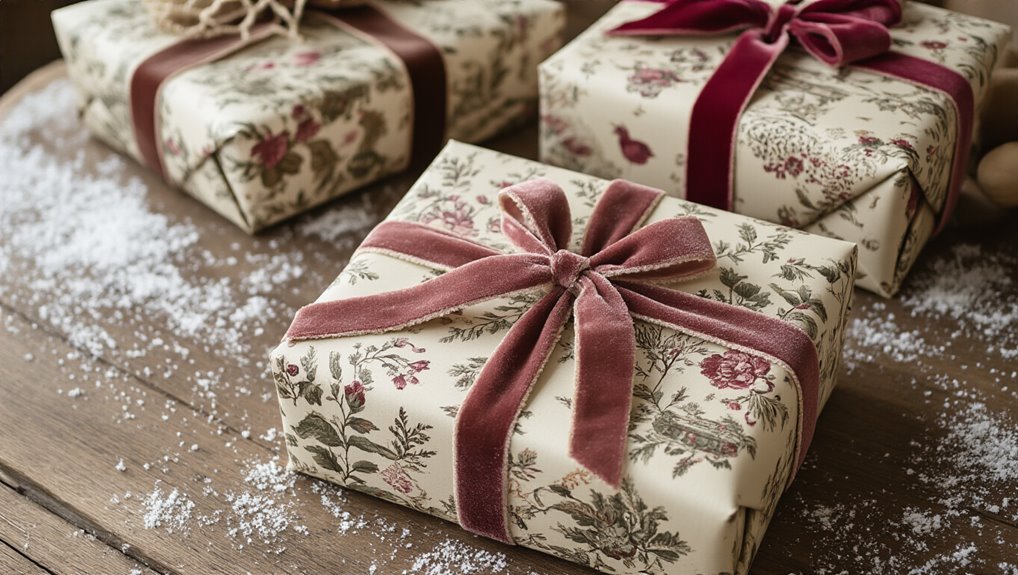
A wave of vintage-inspired prints is returning to holiday wrapping, bringing classic motifs like Victorian holly, mid-century ornaments, and faded toile back into rotation. Designers and shoppers favor papers that feel collected: antique floral motifs appear on muted kraft and cream stocks, while vintage illustrated designs evoke storybook scenes and retro ad art.
Manufacturers print subtle distressing and halftone textures so packages read as keepsakes, not trends. Coordinated tags and twine keep presentations restrained; they’ll emphasize craftsmanship over loud foil. Consumers choose limited palettes—deep berry, pine green, warm gold—to unify varied patterns.
Crafters repurpose ephemera like postcards and sheet music to layer nostalgia with modern minimalism. Retailers report steady demand for small-batch runs and artist collaborations that highlight hand-drawn elements and restrained colorways. Wrapping becomes part of gift storytelling, and these prints invite slow, attentive unwrapping that celebrates memory and warmth. They’ll suit modern and traditional homes alike.
Classic Tartan Plaids
Classic tartan plaids rely on traditional color combinations—red-and-green, navy-and-forest, and black-and-gold—to give gifts a familiar holiday feel. Designers often mix plaids with solid ribbons, tags, or boxes, because they’re balancing pattern and avoiding visual clutter.
When paired carefully, a bold tartan and a muted solid create a polished look that feels both cozy and refined.
Traditional Color Combinations
Tartan patterns pair deep pine greens, rich scarlets, and warm golds to evoke hearthside warmth and timeless holiday cheer. Designers favor classic palettes that balance elegant simplicity, muted tones, and subtle contrast. They’re choosing scale and line weight to keep patterns refined, so wrapping feels both nostalgic and modern. Paper textures—matte, slightly brushed, or soft linen—enhance depth without shouting. Small accents like thin metallic threads or matte ribbon add quiet luxury. Table below highlights common trioings and effects.
| Primary | Secondary | Accent |
|---|---|---|
| Pine green | Scarlet | Gold |
| Navy | Cranberry | Ivory |
| Charcoal | Forest | Copper |
Shoppers are advised to match gift size with pattern scale, since large checks can overwhelm small boxes while tiny tattersall checks suit delicate parcels and maintain a composed, classic presentation year after year.
Mixing Plaids With Solids
Designers recommend pairing bold tartan checks with muted solids so the pattern can breathe and the package stays balanced; they’ll echo one of the plaid’s colors in the solid or choose a neutral like ivory, charcoal, or deep pine to ground the look. They suggest keeping scale in mind: large plaids work with small solids or subtle textures, while tiny tartans suit broader solid blocks.
For modern mixes, limit the palette to two or three hues and use ribbon or twine to bridge patterns. This approach reduces visual clutter when mixing contrasting patterns and keeps gift stacks cohesive. Practical tips focus on pairing solid and patterned papers by alternating layers and matching finish—matte solids calm glossy plaids for polished, classic results and elegant charm.

Sustainable Kraft Paper
Because shoppers want less waste and more transparency, sustainable kraft paper has become a go-to for eco-conscious gift wrapping; it’s made from recycled or responsibly sourced fibers, unbleached, and readily recyclable or compostable.
Designers and crafters favor its warm, natural aesthetic and tactile strength, pairing it with twine, dried sprigs, stamps, or simple hand-lettered tags to create understated, elegant presents. Retailers highlight certifications and transparent supply chains to reassure buyers about eco friendly materials and sustainable sourcing, and small businesses use kraft to reflect ethical values.
Kraft paper resists tearing, holds shape, and adapts to stamping, watercolors, or minimal block prints without overpowering a gift’s contents. Consumers appreciate that kraft reduces plastic waste and often fits curbside recycling programs or backyard composts. When styled thoughtfully, sustainable kraft paper communicates care for both recipient and planet, offering a modern, restrained alternative to glossy, single-use wraps and timeless holiday charm.
Metallic Accents and Foils
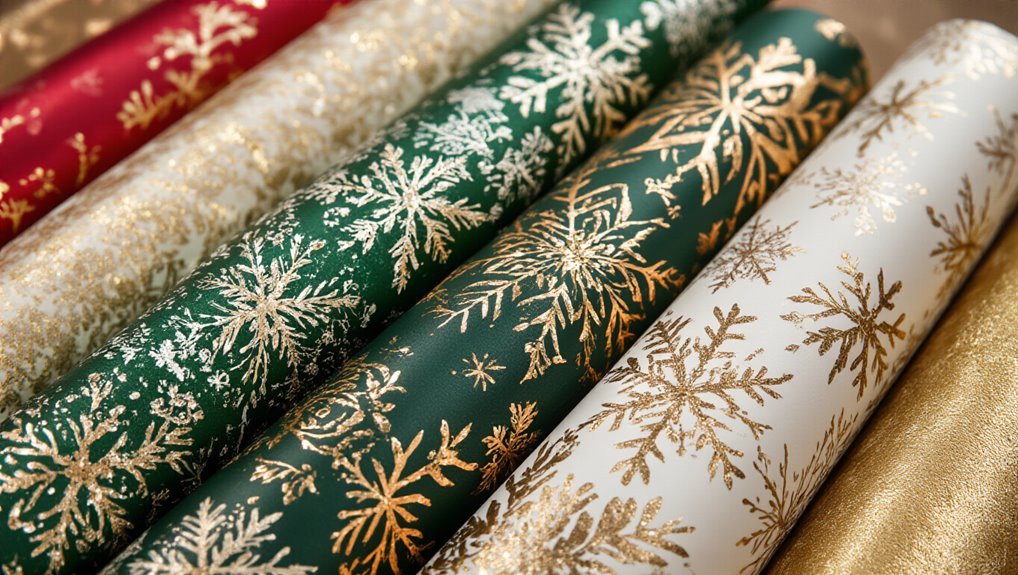
Lustre has pushed metallic accents and foils to the forefront of holiday wrapping, letting small flashes of shine transform simple packages into eye-catching gifts. Designers favor shimmering metallics paired with textured paper to balance glam with warmth. Reflective foils highlight patterns, edges, and custom monograms, creating focal points without overdoing it. Layering matte ribbons with foil tags gives depth and restraint. For eco-conscious decorators, foil accents can be used sparingly to preserve recyclability while still delivering luxe appeal. Shops mix silver, gold, and rose tones to match themes and budgets. The trend is versatile: it suits vintage motifs, modern geometrics, and playful prints. Practical tips encourage trimming foil use to corners or bands, so presentation pops and waste stays minimal.
| Finish | Use |
|---|---|
| Gold foil | Accent bands |
| Silver foil | Monograms |
| Rose foil | Tags & edges |
They recommend balancing sparkle with texture to keep each gift elegant and intentional always.
Minimalist Monochrome Wraps
While holiday wrapping often leans toward loud patterns, minimalist monochrome wraps strip presentation back to a single hue and rely on texture, tone, and negative space to make an elegant statement. Designers favor paper with matte or satin finishes, subtle embossing, and single-color ribbons that emphasize shape over decoration.
This approach uses minimalist color blocking to create contrast through scale and placement rather than multiple colors, so a wide band of deep navy or a blush panel reads modern and refined. Accessories are pared down: twine, wax seals, or a single sprig provide interest without clutter.
For those preferring classic neutrals, tonal grayscale designs offer depth through layered shades of gray, charcoal, and dove, delivering sophistication that suits varied gift sizes. Minimalist monochrome wraps suit thoughtful gifting: they let recipients focus on form and craft, and they’ll fit seamlessly into curated holiday tablescapes and restrained seasonal decor. Elegance.
Nordic-Inspired Scandi Patterns
Scandi design favors clean geometry, soft neutrals, and natural motifs that read calm and cohesive under the tree. Nordic-inspired Scandi patterns bring restrained charm to gift wrapping, pairing simple repeats, subtle texture, and muted palettes. Designers use minimalist scandi designs to emphasize form and function; paper’s often textured with small-scale icons, linear grids, and soft dots that complement rather than compete.
- Limited palette: muted grays, warm creams, dusty blues.
- Pattern scale: tiny repeats for small gifts, broader motifs for larger boxes.
- Finishing touches: matte paper, twine, and simple tags for tactile appeal.
The aesthetic leans into cozy hygge aesthetics without excess, making presents feel thoughtful and serene. Shoppers pick these wraps to create a quiet, unified look beneath the tree; retailers respond with collections that mix classic Nordic geometry and simplicity, ensuring options for gifting. They work equally well for casual holiday gatherings everywhere too.
Botanical and Greenery Motifs
Botanical motifs bring a fresh, organic feel to gift wrap, with designers favoring eucalyptus sprigs, fern fronds, and oversized holly leaves rendered in both realistic and stylized forms. The trend leans toward muted palettes and textured papers that let foliage patterns breathe; metallic accents trace veins and berries for a modern touch.
Small brands pair wraps with twine, dried sprigs, or miniature pinecones, while larger lines print cascading garlands for a bolder statement. Illustrations now include hanging houseplants and banana-inspired tropical leaves alongside classic evergreens, widening seasonal appeal beyond winter greens. Patterns scale from fine repeats for petite gifts to sweeping botanical murals for large presents.
Consumers appreciate sustainable fibers and recyclable inks, and designers’ve answered with compostable options and minimal packaging. Overall, the botanical direction balances elegance and ease, making wrapped presents feel homegrown, curated, and quietly celebratory. Shoppers seek simple ribbons and tags to finish gifts.
Hand-Stamped and Block-Printed Paper
Because artisans press each block by hand, no two sheets are identical, and that slight irregularity is the point: it signals craft, care, and a slower pace of production. The hand-stamped and block-printed approach gives wrapping paper a tactile, human quality.
Designers use hand carved stamps and traditional block printing techniques to create repeating motifs, from minimalist dots to festive foliage. Buyers’ll appreciate sustainable inks, small-batch runs, and the ability to customize palettes. Artisans often recommend simple colorways to let texture read clearly.
For gift-givers who want meaning, these papers communicate true intent and locality without saying a word.
- Texture: subtle relief and ink variance.
- Variety: patterns from tiny repeat to bold medallions.
- Care: gentle handling preserves the impression.
Collectors and crafters will find these sheets work for bows, tags, and wrapping heirloom gifts, makers enjoy the meditative rhythm of carving and printing.
Watercolor and Painterly Designs
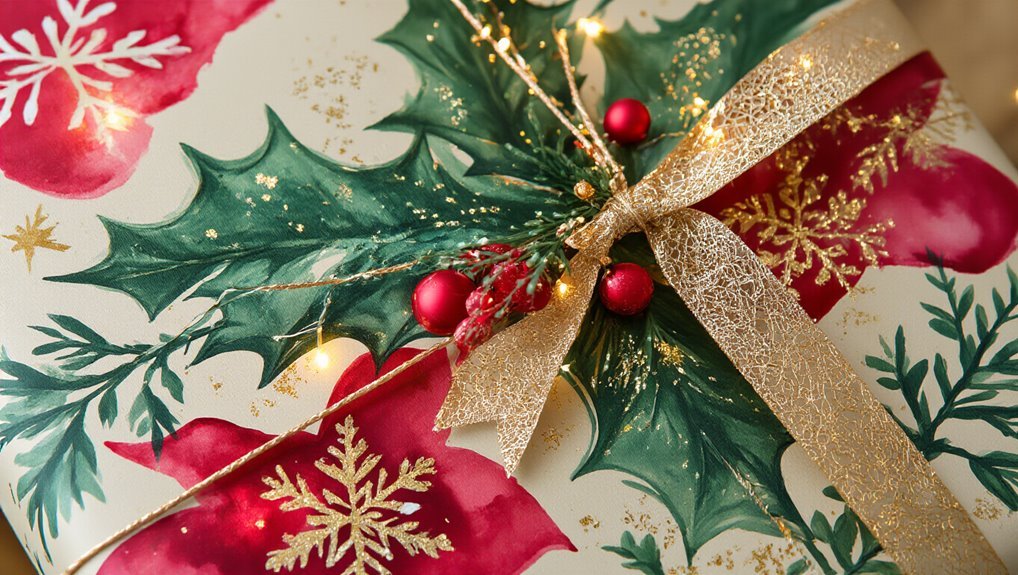
Hand-stamped papers celebrate texture and human touch, while watercolor and painterly designs bring a softer, more fluid expression to gift wrap. Designers favor loose brushstrokes and delicate washes, creating fluid patterns that suggest motion without overpowering packages. Color palettes lean toward muted greens, icy blues, and blush reds, letting watercolor bleed create subtle gradients. Painterly motifs include abstract swirls, washes with metallic accents, and botanical silhouettes rendered in watery layers. These papers pair well with simple ribbons or fiber ties that won’t compete with the artwork. Consumers can choose prints that read as art on small parcels or as bold canvases on larger gifts. The look emphasizes handmade aesthetics while remaining elegant for trees and tables.
| Style | Effect |
|---|---|
| Soft washes | Gentle depth |
| Botanical washes | Natural grace |
| Abstract strokes | Contemporary flair |
Shoppers appreciate versatile sheets that adapt to themes, seasons, and wrapping techniques, offering both subtlety and artistic impact.
Rustic Brown Paper With Twine
When pared back to basics, rustic brown paper tied with twine gives gifts an honest, timeless look that feels both eco-friendly and intentionally unfussy. Designers suggest pairing rustic brown paper accents with simple tags, sprigs of greenery, or stamped initials to create a handcrafted aesthetic.
The appeal is practical: materials are inexpensive, recyclable, and versatile, so households can adapt styles for any recipient.
- Use kraft paper, wrap neatly, and knot twine embellishments for a clean silhouette.
- Layer small natural elements—pine needles, cinnamon sticks, dried orange—for subtle scent and texture.
- Add monochrome stamps or handwritten notes to personalize without clutter.
Shoppers find this trend approachable because it celebrates restraint and attention to detail. Crafters’ll really appreciate how twine and paper work together to highlight thoughtful presentation without relying on glossy prints or gaudy ribbons. Families mix vintage tags and modern minimalism to suit seasonal palettes and personal stories beautifully.
Playful Retro Mid-Century Graphics
Mid-century inspired graphics bring bold shapes, atomic motifs, and saturated colors to gift wrap, evoking the optimism of the 1950s without feeling kitschy. Designers pair mid-century motifs with matte papers and warm metallic accents, creating a fresh vintage vibe that feels deliberate rather than dated.
Patterns feature starbursts, boomerangs, and stylized botanicals rendered in mustard, teal, and coral, giving each present personality. The approach favors playful patterns and clean layouts; it keeps compositions airy so motifs pop.
Wraps often use retro silhouettes—toy rockets, diners, abstract flowers—as focal points, letting simple twine or a narrow grosgrain ribbon finish the look. Shoppers who want nostalgia choose scaled repeats for larger gifts and smaller repeats for boxes, maintaining harmony across a tree.
This trend suits both minimalist homes and eclectic decor, and it lets gift-givers nod to the past while staying thoroughly modern. It’s a cheerful, polished option for seasonal wrapping.
Bold Geometric Patterns
Many designers are embracing bold geometric patterns that use sharp angles, oversized shapes, and high-contrast palettes to make gifts stand out. They favor crisp repeats and contrast, pairing monochrome grids with vibrant accents and bold brushstrokes to inject motion. Geometric layering creates depth, so papers read as modern art rather than mere wrapping; shoppers will reach for patterns that read strong at a glance. Practical touches are kept: scale, color balance, and print finish guide selection so combinations won’t overwhelm a tree.
- Choose one dominant shape to anchor the design.
- Mix scale—large motifs with small supporting tessellations.
- Limit color to two or three hues for high-impact contrast.
Retailers note these patterns photograph well for social media, and crafters find them versatile for tags and ribbons, so bold geometrics will remain a go-to trend. Design teams iterate quickly, testing colorways and repeats to suit contemporary gift aesthetics year-round globally.
Luxurious Velvet-Finish Paper
Designers are turning to velvet-finish paper to add a tactile, luxurious counterpoint to the visual punch of bold geometrics. This paper offers a luxurious velvety texture that invites touch and elevates simple packages into statement pieces.
Brands favor deep jewel tones and muted neutrals, knowing the pile absorbs light and creates a subtle depth. Paired with minimalist ribbons or metallic accents, velvet-finish sheets show off a lustrous sheen without glare, balancing opulence and restraint.
Crafters appreciate its forgiving nature: seams hide beneath the nap, and minor scuffs read as character rather than damage. It’s suited to boutique gifts, specialty boxes, and seasonal keepsakes where presentation matters.
Careful cutting and gentle handling preserve pile direction and surface uniformity, and adhesive choices can prevent matting. For those seeking an upscale look that still feels intimate, velvet-finish paper delivers tactile luxury and refined visual impact across modern and traditional schemes beautifully.
Chalkboard-Style Wrapping
Crafters can choose from matte chalkboard sheets, printable chalkboard paper, or chalk-finish kraft for a modern holiday look. They’ll use hand-lettering techniques—white gel pens, chalk markers, or faux-chalk stamps—to add names and festive sayings with crisp lines or weathered strokes.
Finally, a light spray of fixative or a clear matte sealer will lock in the design and prevent smudging while ribbon and metallic accents provide the finishing touch.
Chalkboard Paper Options
How do chalkboard-style papers reinvent holiday wrapping? Designers showcase chalkboard paper accents and unique chalkboard wrap styles that blend matte black backgrounds with white or metallic highlights. Shoppers can pick printed motifs, pre-lined grids, or writable finishes that accept chalk markers without smudging.
Printed patterns: snowflakes, trees, whimsical icons for quick festive looks.
Writable sheets: erasable surfaces for personalized notes and reusable wraps.
Metallic inks: subtle shimmer that lifts monochrome palettes elegantly.
This approach keeps presents modern and versatile, letting gifters mix textures, ribbons, and twine for layered impact. Retailers stock rolls, gift bags, and tags in matching chalkboard tones. Durable paper and eco-friendly options mean these wraps look sophisticated while remaining practical and sustainably minded and seasonally adaptable designs too.
Hand-Lettering Techniques
Writable chalkboard sheets invite more than printed motifs — they’re the stage for hand-lettering that personalizes every gift. Practitioners choose tools and nibs to explore unique lettering styles, pairing chalk markers with soft pencils for contrast. They practice contemporary calligraphy techniques to mix flourishing scripts with minimalist block letters, producing readable, festive tags and messages.
Designers layer white and colored strokes for depth, while guides and light sketching keep spacing consistent. Because the surface accepts erasure, artists iterate freely, refining composition until balance feels right. Hand-lettering on chalkboard-wrap turns parcels into keepsakes, and recipients notice the care embedded in each stroke.
Artists don’t need mastery to begin; practice yields steady improvement and joyful, personal results. They’ll share these gifts widely with pride throughout the season.
Finishing Touches & Fixatives
A light seal will keep chalkboard-style lettering crisp and smudge-free while preserving that matte, handcrafted look. The writer recommends testing sprays to avoid altering pigments; some fixatives add unwanted shine and gloss, while others maintain satin and matte finishes. They’re suggesting sealing from 12–18 inches in short bursts, letting each coat dry completely.
- Use a workable fixative for corrections.
- Choose a matte sealer to keep the chalk effect.
- Reserve gloss only for accents like metallic inks.
For ribbons and tags, a quick mist protects surfaces without stiffening paper. The designer advises storing wrapped gifts flat and handling gently; proper fixatives preserve texture and keep lettering readable through holiday handling. They recommend labeling fragile notes to avoid smudges during transit and care.
Personalized Photo Wraps
One modern trend turns cherished snapshots into custom gift wrap, letting shoppers print family photos, pet portraits, or travel memories onto sheets that make any present feel instantly personal. Designers suggest using high-resolution images and simple layouts so faces stay clear even when folded.
Print services now offer options like repeating patterns, single-image panels, or subtle overlays to blend photos with holiday motifs. Shoppers can pair prints with custom photo backdrops for tabletop displays, creating a cohesive unwrapping moment. To finish, most recommend adding ribbons, washi tape, or personalized name tags that match the photo palette.
Eco-conscious papers and water-based inks keep images vibrant without harsh chemicals. Small businesses offer templates that auto-crop and preview folds, saving time and reducing waste. Personalized photo wraps suit family gatherings, milestone gifts, and quirky Secret Santa exchanges, and they help recipients relive memories before the ribbon’s even untied. This holiday season.
Celestial Stars and Moon Themes
Many shoppers who used personalized photo wraps now look for designs that evoke wonder rather than memories, and celestial stars-and-moon themes answer that need with ethereal geometry and soft metallics. Designers favor deep navy bases punctuated by brass moons and silver stars, so packages feel like tiny night skies.
Retailers’ll promote sheets that mix matte and foil to enhance contrast, and crafters pair ribbons that echo cosmic patterns for a cohesive look. The aesthetic leans modern but stays warm, suitable for adults and children.
- Choose large moons for focal impact.
- Layer star-print tissue under translucent wrap.
- Add metallic twine to highlight edges.
Stylists recommend keeping patterns balanced: use celestial silhouettes sparingly to avoid clutter, and match scale across tags, boxes, and bows for a polished, otherworldly presentation. Shoppers will find mixes of subtle foil and deep hues that elevate wrapping without overpowering gifts each season today.
Festive Plaid and Gingham Mixes
Several designers are leaning into festive plaids and gingham mixes that blend traditional tartans with scaled-down checks. They’ve favored color palettes that nod to classic crimson and forest green while introducing muted pastels and metallic threads now for contrast.
Patterns alternate between bold, oversized tartans and fine gingham grids, so packages feel layered without clutter. Designers recommend pairing these prints with solid ribbons or kraft tags to keep presentation crisp. The versatility suits vintage themes and modern minimalism alike, and retailers tag many as holiday inspired designs to catch seasonal shoppers’ eyes.
Small-scale gingham gets used on bows and liners, acting as subtle texture against dominant plaids. Shoppers find the look works well for both family heirlooms and casual exchanges, and crafters use coordinating stickers and wraps as seasonal accent pieces to finish the effect. Overall, the trend balances tradition and freshness for memorable gift presentation and joyful gatherings.
DIY Stenciled and Painted Sheets
How can plain paper become standout wrapping with just a stencil, a brush, and a bit of paint? The creator picks simple kraft, white, or colored rolls and applies diy stencil designs to build rhythm and charm. They’ll tape stencils, dab low-moisture acrylics, and repeat patterns for cohesive sets. For a modern twist, they alternate metallic accents and matte fields, producing custom painted sheets that match ribbons and tags. This approach saves money, reduces waste, and invites personalization for recipients.
- Choose repeatable motifs: stars, pine silhouettes, geometric lines.
- Select paint thickness: dry brush for texture, fuller coats for opacity.
- Finish smart: heat-set or spray fixative to prevent smudging.
The maker experiments with scale and spacing, creating gift bundles that look curated. These stenciled sheets give presents an artisan feel without needing advanced skills. They’ll personalize colors for each recipient and label boldly for easy gifting.
Embossed and Textured Papers
The section on embossed and textured papers highlights how tactile finishes can elevate holiday packages, covering common embossing types like blind, registered, and foil-stamped patterns.
It’ll outline texture application techniques—heat, pressure, embossing rolls, and hand-tooling—that produce raised and tactile effects.
The piece also covers finishes and materials, from matte and metallic coatings to linen, cotton, and recycled textured stocks.
Types of Embossing
While embossing raises precise patterns into paper using matched dies to create clean, repeatable motifs, textured papers rely on fiber formation or mechanical finishes—like linen, hammered, or felt—to produce irregular, tactile surfaces.
Types of embossing include blind embossing for subtle raised patterns, registered embossing that aligns motifs with printed art, and embossing combined with foil for contrast; debossed finishes press designs into the sheet for depth and shadow.
Designers choose techniques by desired contrast, scale, and durability. Embossing enhances perceived value and guides light for festive sparkle, while debossing adds understated elegance.
Consider stock weight and die detail: heavy stock holds crisp relief, fine detail favors softer impressions. Sample tests guarantee it’s meeting tactile and visual goals.
- Blind
- Registered
- Foil accents
Texture Application Techniques
Start by considering how embossing and texturing methods will interact with print, finish, and handling: designers and manufacturers choose between die-based embossing (sheet or rotary) for crisp relief, blind or registered embosses for alignment with art, and mechanical or formation-based textures—like calendering, felt- or linen-roll finishes, and laid papers—for irregular, tactile surfaces.
They balance visual depth and durability, selecting patterns that read at gift scale. Dimensional textures create shadows and inviting touch, while layered applications combine embossing with printing layers and selective ink density to emphasize motifs without overwhelming design.
Production teams test registration, paper weight, and tooling to prevent cracking or flattening. Retailers favor textures that photograph well and survive wrapping, shipping, and unwrapping. They’ll iterate rapidly to refine tactile impact and cost.
Finishes and Materials
Three core finishes — matte, satin, and gloss — shape how embossing reads, catches light, and photographs. Designers favor embossed patterns that pair with shimmering finishes to highlight raised motifs without overpowering prints. Textured papers invite touch; tactile materials like cotton-linen blends, vellum, and heavy recycled stocks add depth and durability. Each choice alters perceived value and unwrapping drama.
- Matte: mutes shine, emphasizes texture and subtle embossing.
- Satin: soft sheen that balances contrast and elegance.
- Gloss: maximizes reflection for bold, high-impact highlights.
Shoppers and crafters can mix finishes, layering vellum overlays or metallic foils for contrast. Retailers recommend testing paper-weight and emboss depth to guarantee clean folds and consistent impressions. They’ll find better results when matching grain direction to folds regularly.
Holiday Animal and Woodland Scenes
Many designers are leaning into holiday animal and woodland scenes, pairing foxes, deer, owls, and pine-clad landscapes with muted palettes and hand-drawn lines. Prints feature whimsical forest critters, charming winter wildlife, and minimalist silhouettes that’ll suit contemporary and rustic homes alike.
Studios favor limited colorways—sage, oatmeal, deep berry—and textured papers to evoke bark and snow. Small-scale repeats and panoramic vignettes give options for tiny boxes or large parcels, while metallic accents highlight antlers, hoarfrost, or starry skies without overwhelming the design.
Consumers appreciate patterns that read as art on display, so collaborations with illustrators and letterpress studios are rising. Eco-conscious mills answer demand with recycled stocks and vegetable inks that keep woodland themes authentic.
Retailers offer curated collections that carefully mix playful scenes with subtle seasonal motifs, letting shoppers layer prints for cohesive stacks under the tree. Designers keep motifs timeless, avoiding trendy clichés so these wraps remain beloved yearly.
Gift-Tag and Ribbon Focused Wraps
While designers pare back patterned paper, they push tags and ribbons to the foreground, turning closures into the main visual statement. The movement spotlights thoughtful details:
- Oversized tags
- Layered textures
- Sculptural bows
Designers cite gift tag trends that favor handcrafted materials, typographic labels and sustainable fibers, and they match those with bold ribbon accents in velvet, grosgrain and metallics. Wraps use neutral paper to let tags and ribbons dominate, creating a gallery-like effect on mantels and under trees.
Practicality meets style as tags double as keepsakes and ribbon becomes structural, holding sprigs, charms or pinecones. Shoppers are advised to mix scales and materials, keep palettes limited, and use repetition for impact. The approach suits DIYers and professionals alike, offering visual return with minimal paper design.
Adopt these tactics to convert simple parcels into curated presentations that read as gifts when opened. They celebrate intentional presentation.
Frequently Asked Questions
How Do I Store Leftover Wrapping Paper Without Creasing?
They’ll avoid creases by rolling up paper around a sturdy tube, smoothing as they go, and securing with a loose elastic or clip.
For long-term care they’ll store paper rolls upright in a tall box, keeping paper rolls separated from moisture and heavy items.
If sheets are left, they’ll lay them flat between tissue or cardboard.
They’ll check periodically and replace elastics to keep papers pristine and avoid folds daily.
Are Some Wrapping Papers Flammable or Unsafe Near Candles?
Yes, some wrapping papers are flammable and unsafe near candles. They often contain metallic foils, glossy coatings, or plastic layers that ignite quickly, raising fire hazard concerns.
People should always keep wrapped gifts well away from flames and use battery-operated candles. If paper is burned, it’ll release toxic fumes, so they should choose flame-resistant options and follow safe disposal options like recycling plain paper or bagging coated scraps for trash.
What Is the Best Way to Wrap Oddly Shaped Gifts?
They’ll start by securing oddly shaped gifts with tissue and a snug box when possible; if not, they’ll use furoshiki or fabric wrap and ribbon to mold around curves.
They’ll layer crinkle paper, tape strategically, and add boxes or inserts to stabilize. These gift wrapping techniques and creative packaging ideas keep presents tidy and attractive.
They don’t force paper; they embrace bows, tags, and twine to finish beautifully with flair.
How Can I Save Money Buying Wrapping Paper in Bulk?
They save money buying wrapping paper in bulk by comparing bulk pricing discounts and tapping wholesale wrapping paper sources; they’ll buy generic designs, mix rolls by size, and order seasonal overstock.
They negotiate shipping, split cases with friends, and use subscription deals to lock lower rates. They store rolls properly to avoid waste, reuse ribbon and tissue, and plan gifts around what they already bought so savings stack big time.
Are There Hypoallergenic Wrapping Paper Options for Sensitive People?
Yes, they can find hypoallergenic wrapping paper; manufacturers list hypoallergenic materials used like unbleached cotton fiber, chlorine-free pulp and soy-based inks.
They can choose eco friendly paper options such as recycled kraft, uncoated tree-free papers, and compostable cellophane. They’ll avoid fragrances, latex-based adhesives, and glitter that can irritate. They’ll test a small piece first and look for certifications like FSC, Green Seal, or allergy-friendly labels before wider use and packaging.
Conclusion
This Christmas, don’t settle for plain old wrapping paper. Embrace the season’s hottest trends – from vintage-inspired prints to sustainable kraft paper and metallic accents. With so many stunning options, you’re sure to find the perfect fit for every gift. Get creative and make your presents shine with these must-try Christmas gift wrapping paper ideas.